Again Assuming a Transformation From F(T)=-6t^t
LEARNING OBJECTIVES
By the end of this lesson, you will exist able to:
- Graph functions using vertical and horizontal shifts.
- Graph functions using reflections about the [latex]x[/latex] -axis and the [latex]y[/latex] -centrality.
- Make up one's mind whether a role is even, odd, or neither from its graph.
- Graph functions using compressions and stretches.
- Combine transformations.

Figure 1.(credit: "Misko"/Flickr)
We all know that a flat mirror enables us to run into an authentic prototype of ourselves and whatever is backside u.s.. When nosotros tilt the mirror, the images nosotros encounter may shift horizontally or vertically. Just what happens when we bend a flexible mirror? Like a funfair funhouse mirror, it presents u.s. with a distorted image of ourselves, stretched or compressed horizontally or vertically. In a similar way, we can misconstrue or transform mathematical functions to better adapt them to describing objects or processes in the real world. In this section, nosotros volition take a look at several kinds of transformations.
Graphing Functions Using Vertical and Horizontal Shifts
Often when given a problem, nosotros endeavour to model the scenario using mathematics in the class of words, tables, graphs, and equations. One method we tin can employ is to suit the basic graphs of the toolkit functions to build new models for a given scenario. There are systematic means to alter functions to construct appropriate models for the issues we are trying to solve.
Identifying Vertical Shifts
I simple kind of transformation involves shifting the entire graph of a function up, down, right, or left. The simplest shift is a vertical shift, moving the graph upwardly or down, because this transformation involves calculation a positive or negative constant to the function. In other words, nosotros add the same abiding to the output value of the function regardless of the input. For a function [latex]chiliad\left(10\right)=f\left(10\right)+chiliad[/latex], the function [latex]f\left(x\right)[/latex] is shifted vertically [latex]k[/latex] units.

Figure 2. Vertical shift by [latex]yard=1[/latex] of the cube root office [latex]f\left(x\right)=\sqrt[3]{x}[/latex].
To help y'all visualize the concept of a vertical shift, consider that [latex]y=f\left(10\correct)[/latex]. Therefore, [latex]f\left(ten\correct)+k[/latex] is equivalent to [latex]y+k[/latex]. Every unit of measurement of [latex]y[/latex] is replaced past [latex]y+m[/latex], so the [latex]y\text{-}[/latex] value increases or decreases depending on the value of [latex]chiliad[/latex]. The result is a shift upward or downwardly.
A General Note: Vertical Shift
Given a part [latex]f\left(ten\right)[/latex], a new function [latex]g\left(ten\right)=f\left(x\right)+k[/latex], where [latex]k[/latex] is a abiding, is a vertical shift of the function [latex]f\left(ten\right)[/latex]. All the output values change past [latex]k[/latex] units. If [latex]thou[/latex] is positive, the graph will shift up. If [latex]one thousand[/latex] is negative, the graph will shift down.
Example 1: Adding a Constant to a Function
To regulate temperature in a green building, airflow vents well-nigh the roof open and close throughout the day. Figure 2 shows the area of open vents [latex]V[/latex] (in square feet) throughout the day in hours after midnight, [latex]t[/latex]. During the summertime, the facilities manager decides to try to better regulate temperature by increasing the amount of open vents by twenty square feet throughout the 24-hour interval and night. Sketch a graph of this new office.
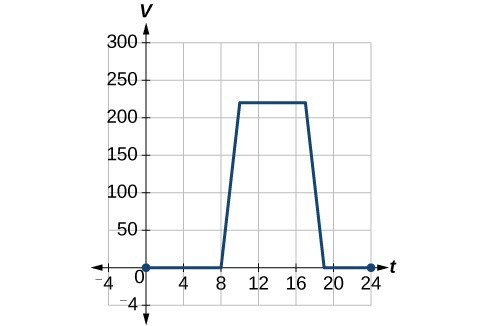
Figure 3
Solution
Nosotros can sketch a graph of this new function by adding xx to each of the output values of the original function. This will have the effect of shifting the graph vertically upwardly, as shown in Figure 4.
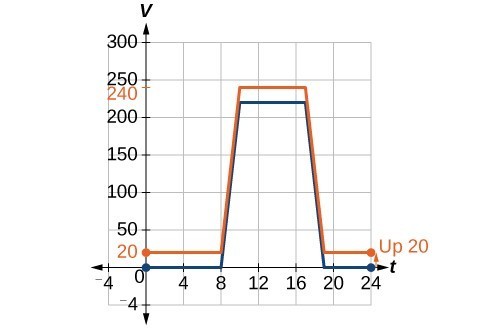
Figure four
Observe that for each input value, the output value has increased past twenty, and so if we telephone call the new part [latex]Due south\left(t\right)[/latex], nosotros could write
[latex]S\left(t\right)=V\left(t\correct)+20[/latex]
This annotation tells united states that, for any value of [latex]t,South\left(t\right)[/latex] can exist establish past evaluating the part [latex]V[/latex] at the same input and and then adding xx to the upshot. This defines [latex]Due south[/latex] every bit a transformation of the part [latex]V[/latex], in this example a vertical shift upwards 20 units. Discover that, with a vertical shift, the input values stay the same and simply the output values change.
| [latex]t[/latex] | 0 | 8 | 10 | 17 | 19 | 24 |
| [latex]Five\left(t\right)[/latex] | 0 | 0 | 220 | 220 | 0 | 0 |
| [latex]S\left(t\right)[/latex] | 20 | 20 | 240 | 240 | 20 | 20 |
How To: Given a tabular function, create a new row to stand for a vertical shift.
- Identify the output row or cavalcade.
- Make up one's mind the magnitude of the shift.
- Add the shift to the value in each output cell. Add a positive value for up or a negative value for down.
Instance 2: Shifting a Tabular Function Vertically
A office [latex]f\left(x\right)[/latex] is given below. Create a tabular array for the function [latex]g\left(ten\right)=f\left(ten\right)-3[/latex].
| [latex]x[/latex] | 2 | 4 | half-dozen | viii |
| [latex]f\left(x\right)[/latex] | 1 | 3 | 7 | 11 |
Solution
The formula [latex]g\left(x\correct)=f\left(10\right)-iii[/latex] tells united states of america that we tin detect the output values of [latex]g[/latex] by subtracting iii from the output values of [latex]f[/latex]. For example:
[latex]\begin{cases}f\left(2\correct)=i\hfill & \text{Given}\hfill \\ yard\left(x\right)=f\left(x\right)-3\hfill & \text{Given transformation}\hfill \\ chiliad\left(2\right)=f\left(two\right)-3\hfill & \hfill \\ =1 - three\hfill & \hfill \\ =-2\hfill & \hfill \end{cases}[/latex]
Subtracting 3 from each [latex]f\left(x\correct)[/latex] value, we can consummate a table of values for [latex]g\left(x\right)[/latex].
| [latex]ten[/latex] | 2 | 4 | 6 | 8 |
| [latex]f\left(x\right)[/latex] | ane | three | seven | 11 |
| [latex]g\left(x\correct)[/latex] | −2 | 0 | four | 8 |
The function [latex]h\left(t\right)=-4.9{t}^{two}+30t[/latex] gives the height [latex]h[/latex] of a brawl (in meters) thrown upwards from the footing afterwards [latex]t[/latex] seconds. Suppose the brawl was instead thrown from the top of a 10-thousand building. Chronicle this new summit function [latex]b\left(t\right)[/latex] to [latex]h\left(t\correct)[/latex], and and so find a formula for [latex]b\left(t\right)[/latex].
[latex]b\left(t\right)=h\left(t\right)+10=-4.9{t}^{ii}+30t+10[/latex]
Identifying Horizontal Shifts
We only saw that the vertical shift is a change to the output, or outside, of the function. Nosotros will now expect at how changes to input, on the inside of the function, alter its graph and meaning. A shift to the input results in a movement of the graph of the office left or right in what is known as a horizontal shift.
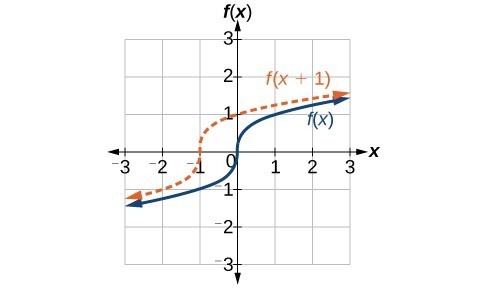
Figure five. Horizontal shift of the function [latex]f\left(10\right)=\sqrt[3]{x}[/latex]. Note that [latex]h=+1[/latex] shifts the graph to the left, that is, towards negative values of [latex]ten[/latex].
For instance, if [latex]f\left(x\right)={x}^{two}[/latex], then [latex]g\left(x\correct)={\left(ten - 2\correct)}^{2}[/latex] is a new function. Each input is reduced by 2 prior to squaring the function. The outcome is that the graph is shifted two units to the right, because we would need to increase the prior input by 2 units to yield the same output value every bit given in [latex]f[/latex].
A General Annotation: Horizontal Shift
Given a function [latex]f[/latex], a new function [latex]thousand\left(x\right)=f\left(10-h\correct)[/latex], where [latex]h[/latex] is a abiding, is a horizontal shift of the function [latex]f[/latex]. If [latex]h[/latex] is positive, the graph volition shift right. If [latex]h[/latex] is negative, the graph will shift left.
Example 3: Adding a Constant to an Input
Returning to our building airflow example from Instance 2, suppose that in autumn the facilities manager decides that the original venting plan starts too late, and wants to begin the entire venting program ii hours earlier. Sketch a graph of the new function.
Solution
We can gear up [latex]Five\left(t\right)[/latex] to exist the original program and [latex]F\left(t\right)[/latex] to be the revised program.
[latex]\brainstorm{cases}{c}V\left(t\right)=\text{ the original venting programme}\\ \text{F}\left(t\right)=\text{starting ii hrs sooner}\finish{cases}[/latex]
In the new graph, at each time, the airflow is the same as the original function [latex]V[/latex] was two hours after. For example, in the original function [latex]Five[/latex], the airflow starts to alter at 8 a.m., whereas for the role [latex]F[/latex], the airflow starts to change at 6 a.k. The comparable role values are [latex]V\left(8\right)=F\left(six\right)[/latex]. Observe also that the vents first opened to [latex]220{\text{ ft}}^{ii}[/latex] at 10 a.m. under the original plan, while under the new programme the vents reach [latex]220{\text{ ft}}^{\text{2}}[/latex] at 8 a.m., so [latex]V\left(10\right)=F\left(8\correct)[/latex].
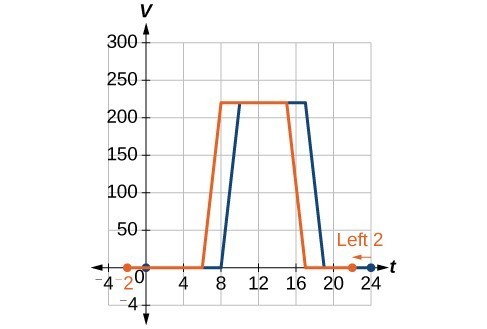
Figure six
In both cases, we see that, because [latex]F\left(t\right)[/latex] starts 2 hours sooner, [latex]h=-2[/latex]. That means that the same output values are reached when [latex]F\left(t\correct)=V\left(t-\left(-2\right)\right)=5\left(t+two\correct)[/latex].
How To: Given a tabular office, create a new row to represent a horizontal shift.
- Identify the input row or column.
- Make up one's mind the magnitude of the shift.
- Add the shift to the value in each input cell.
Example 4: Shifting a Tabular Function Horizontally
A office [latex]f\left(10\correct)[/latex] is given below. Create a table for the function [latex]g\left(x\correct)=f\left(ten - three\right)[/latex].
| [latex]x[/latex] | 2 | 4 | 6 | 8 |
| [latex]f\left(x\right)[/latex] | one | three | 7 | 11 |
Solution
The formula [latex]1000\left(10\right)=f\left(x - 3\correct)[/latex] tells united states that the output values of [latex]k[/latex] are the same every bit the output value of [latex]f[/latex] when the input value is 3 less than the original value. For instance, nosotros know that [latex]f\left(two\right)=1[/latex]. To get the same output from the office [latex]k[/latex], we will demand an input value that is 3 larger. Nosotros input a value that is 3 larger for [latex]g\left(ten\right)[/latex] because the function takes three away before evaluating the function [latex]f[/latex].
[latex]\brainstorm{cases}g\left(5\right)=f\left(five - 3\right)\hfill \\ =f\left(ii\right)\hfill \\ =1\hfill \cease{cases}[/latex]
We continue with the other values to create this tabular array.
| [latex]ten[/latex] | 5 | 7 | ix | xi |
| [latex]10 - 3[/latex] | 2 | 4 | 6 | 8 |
| [latex]f\left(10\right)[/latex] | 1 | 3 | seven | 11 |
| [latex]g\left(10\correct)[/latex] | 1 | 3 | 7 | eleven |
The result is that the function [latex]thousand\left(x\right)[/latex] has been shifted to the right by 3. Observe the output values for [latex]m\left(x\right)[/latex] remain the same as the output values for [latex]f\left(x\correct)[/latex], but the corresponding input values, [latex]x[/latex], have shifted to the right by 3. Specifically, 2 shifted to 5, 4 shifted to 7, half-dozen shifted to 9, and 8 shifted to 11.
Example five: Identifying a Horizontal Shift of a Toolkit Function
This graph represents a transformation of the toolkit part [latex]f\left(ten\right)={x}^{2}[/latex]. Relate this new office [latex]chiliad\left(10\right)[/latex] to [latex]f\left(10\right)[/latex], and so observe a formula for [latex]g\left(x\correct)[/latex].
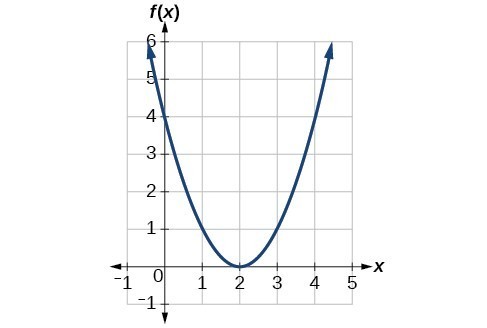
Effigy eight
Solution
Notice that the graph is identical in shape to the [latex]f\left(x\correct)={x}^{2}[/latex] role, but the x-values are shifted to the right 2 units. The vertex used to exist at (0,0), but now the vertex is at (ii,0). The graph is the basic quadratic role shifted 2 units to the right, so
[latex]chiliad\left(10\right)=f\left(x - 2\right)[/latex]
Find how we must input the value [latex]x=2[/latex] to go the output value [latex]y=0[/latex]; the x-values must be 2 units larger because of the shift to the right by 2 units. We tin so utilise the definition of the [latex]f\left(x\right)[/latex] function to write a formula for [latex]g\left(10\right)[/latex] by evaluating [latex]f\left(x - 2\right)[/latex].
[latex]\brainstorm{cases}f\left(10\right)={x}^{2}\hfill \\ g\left(x\right)=f\left(x - 2\right)\hfill \\ thousand\left(ten\right)=f\left(10 - 2\right)={\left(x - ii\right)}^{2}\hfill \terminate{cases}[/latex]
Example half dozen: Interpreting Horizontal versus Vertical Shifts
The function [latex]M\left(m\right)[/latex] gives the number of gallons of gas required to drive [latex]1000[/latex] miles. Interpret [latex]Chiliad\left(m\right)+10[/latex] and [latex]1000\left(m+10\right)[/latex].
Solution
[latex]K\left(one thousand\correct)+10[/latex] can be interpreted equally adding 10 to the output, gallons. This is the gas required to bulldoze [latex]m[/latex] miles, plus another 10 gallons of gas. The graph would indicate a vertical shift.
[latex]M\left(yard+10\right)[/latex] tin be interpreted equally adding x to the input, miles. And then this is the number of gallons of gas required to drive 10 miles more [latex]m[/latex] miles. The graph would bespeak a horizontal shift.
Attempt It 1
Given the office [latex]f\left(ten\correct)=\sqrt{ten}[/latex], graph the original function [latex]f\left(ten\correct)[/latex] and the transformation [latex]1000\left(10\right)=f\left(x+2\right)[/latex] on the same axes. Is this a horizontal or a vertical shift? Which fashion is the graph shifted and by how many units?
Solution
Graphing Functions Using Reflections about the Axes
Another transformation that tin can be practical to a office is a reflection over the ten– or y-axis. A vertical reflection reflects a graph vertically across the x-axis, while a horizontal reflection reflects a graph horizontally across the y-axis. The reflections are shown in Figure nine.
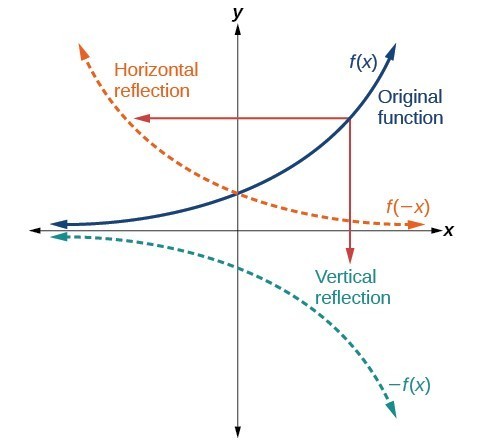
Figure 9. Vertical and horizontal reflections of a function.
Notice that the vertical reflection produces a new graph that is a mirror paradigm of the base or original graph near the x-centrality. The horizontal reflection produces a new graph that is a mirror image of the base or original graph most the y-centrality.
A Full general Annotation: Reflections
Given a function [latex]f\left(x\right)[/latex], a new office [latex]g\left(x\correct)=-f\left(x\right)[/latex] is a vertical reflection of the function [latex]f\left(x\correct)[/latex], sometimes called a reflection almost (or over, or through) the x-axis.
Given a function [latex]f\left(x\right)[/latex], a new part [latex]g\left(10\right)=f\left(-10\correct)[/latex] is a horizontal reflection of the function [latex]f\left(ten\correct)[/latex], sometimes called a reflection about the y-axis.
How To: Given a part, reflect the graph both vertically and horizontally.
- Multiply all outputs by –1 for a vertical reflection. The new graph is a reflection of the original graph about the x-axis.
- Multiply all inputs by –ane for a horizontal reflection. The new graph is a reflection of the original graph about the y-axis.
Example 7: Reflecting a Graph Horizontally and Vertically
Reverberate the graph of [latex]due south\left(t\right)=\sqrt{t}[/latex] (a) vertically and (b) horizontally.
Solution
a. Reflecting the graph vertically means that each output value will be reflected over the horizontal t-axis as shown in Figure 10.
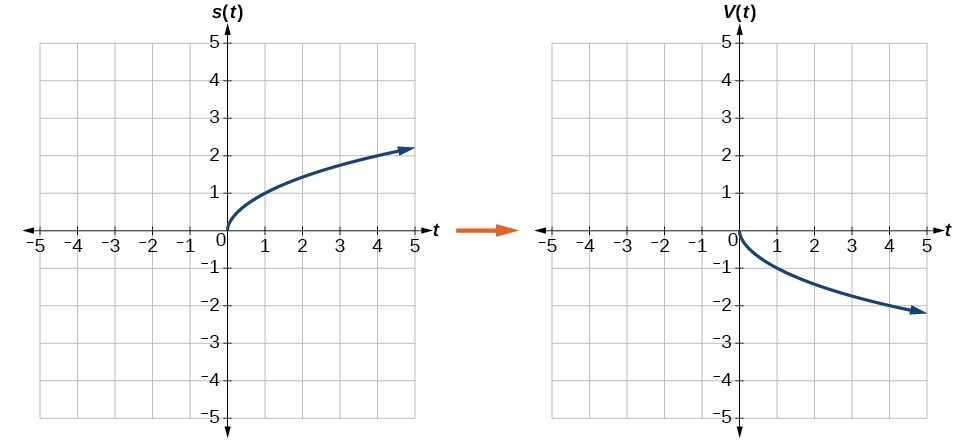
Figure 10.Vertical reflection of the square root function
Considering each output value is the opposite of the original output value, nosotros can write
[latex]V\left(t\right)=-south\left(t\right)\text{ or }V\left(t\right)=-\sqrt{t}[/latex]
Notice that this is an outside change, or vertical shift, that affects the output [latex]due south\left(t\right)[/latex] values, and then the negative sign belongs exterior of the part.
b.
Reflecting horizontally means that each input value volition be reflected over the vertical axis as shown in Figure 11.

Effigy 11. Horizontal reflection of the square root function
Because each input value is the opposite of the original input value, we can write
[latex]H\left(t\correct)=s\left(-t\right)\text{ or }H\left(t\right)=\sqrt{-t}[/latex]
Notice that this is an within change or horizontal alter that affects the input values, so the negative sign is on the within of the office.
Note that these transformations tin affect the domain and range of the functions. While the original square root function has domain [latex]\left[0,\infty \correct)[/latex] and range [latex]\left[0,\infty \correct)[/latex], the vertical reflection gives the [latex]V\left(t\right)[/latex] function the range [latex]\left(-\infty ,0\right][/latex] and the horizontal reflection gives the [latex]H\left(t\right)[/latex] function the domain [latex]\left(-\infty ,0\correct][/latex].
Try It 2
Reflect the graph of [latex]f\left(x\right)=|x - i|[/latex] (a) vertically and (b) horizontally.
Solution
Example 8: Reflecting a Tabular Function Horizontally and Vertically
A function [latex]f\left(x\right)[/latex] is given. Create a table for the functions below.
- [latex]g\left(x\right)=-f\left(ten\right)[/latex]
- [latex]h\left(x\right)=f\left(-x\right)[/latex]
| [latex]10[/latex] | 2 | 4 | 6 | viii |
| [latex]f\left(x\correct)[/latex] | one | iii | 7 | eleven |
Solution
-
For [latex]g\left(10\correct)[/latex], the negative sign outside the part indicates a vertical reflection, and so the 10-values stay the same and each output value volition exist the contrary of the original output value.
[latex]10[/latex] 2 4 6 viii [latex]grand\left(x\right)[/latex] –i –iii –7 –eleven -
For [latex]h\left(x\right)[/latex], the negative sign within the function indicates a horizontal reflection, and so each input value volition be the opposite of the original input value and the [latex]h\left(x\right)[/latex] values stay the same as the [latex]f\left(ten\right)[/latex] values.
[latex]x[/latex] −2 −four −6 −8 [latex]h\left(x\correct)[/latex] one iii 7 11
Attempt It iii
| [latex]x[/latex] | −2 | 0 | two | 4 |
| [latex]f\left(ten\correct)[/latex] | 5 | 10 | fifteen | xx |
Using the function [latex]f\left(10\right)[/latex] given in the tabular array above, create a table for the functions below.
a. [latex]m\left(x\right)=-f\left(10\right)[/latex]
b. [latex]h\left(x\right)=f\left(-x\right)[/latex]
Solution
Determining Even and Odd Functions
Some functions exhibit symmetry so that reflections result in the original graph. For example, horizontally reflecting the toolkit functions [latex]f\left(x\right)={ten}^{2}[/latex] or [latex]f\left(ten\correct)=|x|[/latex] will result in the original graph. We say that these types of graphs are symmetric virtually the y-axis. Functions whose graphs are symmetric almost the y-axis are called even functions.
If the graphs of [latex]f\left(x\right)={x}^{three}[/latex] or [latex]f\left(x\right)=\frac{1}{x}[/latex] were reflected over both axes, the result would be the original graph.
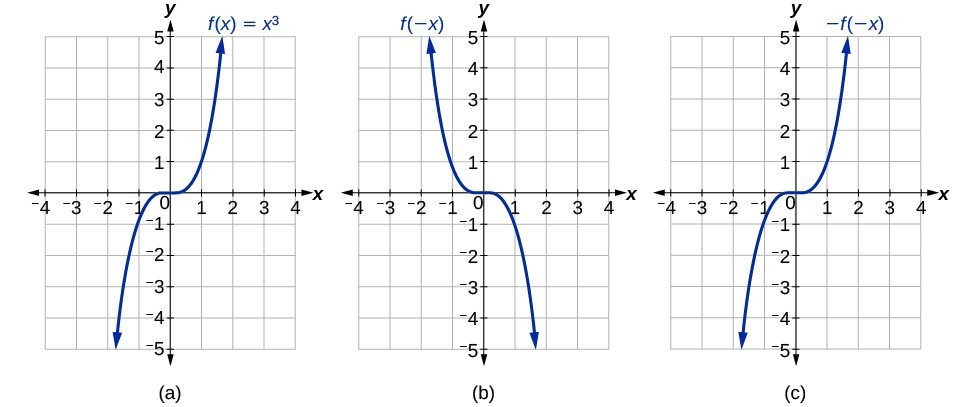
Figure 12. (a) The cubic toolkit role (b) Horizontal reflection of the cubic toolkit function (c) Horizontal and vertical reflections reproduce the original cubic role.
We say that these graphs are symmetric about the origin. A office with a graph that is symmetric almost the origin is called an odd function.
Note: A function can be neither even nor odd if information technology does non showroom either symmetry. For example, [latex]f\left(x\right)={2}^{x}[/latex] is neither even nor odd. As well, the only function that is both even and odd is the abiding function [latex]f\left(ten\right)=0[/latex].
A Full general Note: Even and Odd Functions
A office is called an even function if for every input [latex]x[/latex]
[latex]f\left(x\right)=f\left(-10\right)[/latex]
The graph of an even role is symmetric well-nigh the [latex]y\text{-}[/latex] axis.
A function is called an odd role if for every input [latex]x[/latex]
[latex]f\left(ten\right)=-f\left(-x\right)[/latex]
The graph of an odd part is symmetric about the origin.
How To: Given the formula for a function, decide if the role is even, odd, or neither.
- Decide whether the part satisfies [latex]f\left(x\right)=f\left(-x\correct)[/latex]. If information technology does, it is fifty-fifty.
- Determine whether the office satisfies [latex]f\left(x\right)=-f\left(-x\right)[/latex]. If it does, information technology is odd.
- If the function does non satisfy either rule, it is neither even nor odd.
Case 9: Determining whether a Function Is Even, Odd, or Neither
Is the function [latex]f\left(x\right)={x}^{3}+2x[/latex] even, odd, or neither?
Solution
Without looking at a graph, we can determine whether the function is fifty-fifty or odd by finding formulas for the reflections and determining if they return us to the original function. Let's brainstorm with the rule for even functions.
[latex]f\left(-x\right)={\left(-x\correct)}^{3}+ii\left(-x\right)=-{x}^{iii}-2x[/latex]
This does not return us to the original function, and so this role is non even. We tin can now test the rule for odd functions.
[latex]-f\left(-x\right)=-\left(-{x}^{3}-2x\right)={x}^{3}+2x[/latex]
Because [latex]-f\left(-x\right)=f\left(x\right)[/latex], this is an odd part.
Try It 4
Is the function [latex]f\left(s\right)={southward}^{four}+3{s}^{two}+7[/latex] even, odd, or neither?
Solution
Graphing Functions Using Stretches and Compressions
Calculation a constant to the inputs or outputs of a function changed the position of a graph with respect to the axes, but information technology did non affect the shape of a graph. Nosotros now explore the effects of multiplying the inputs or outputs by some quantity.
We can transform the inside (input values) of a function or nosotros can transform the outside (output values) of a role. Each change has a specific issue that tin can be seen graphically.
Vertical Stretches and Compressions
When nosotros multiply a function by a positive abiding, we go a function whose graph is stretched or compressed vertically in relation to the graph of the original function. If the constant is greater than i, we get a vertical stretch; if the constant is betwixt 0 and i, we get a vertical compression. The graph below shows a function multiplied by constant factors 2 and 0.5 and the resulting vertical stretch and compression.
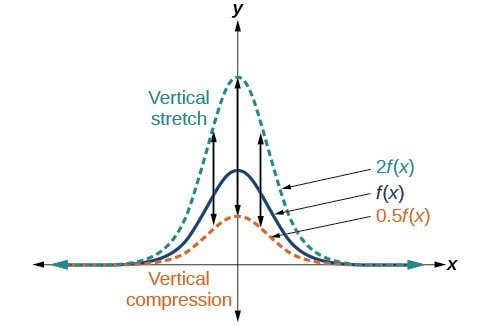
Figure 14. Vertical stretch and compression
A General Annotation: Vertical Stretches and Compressions
Given a function [latex]f\left(x\correct)[/latex], a new function [latex]g\left(x\correct)=af\left(x\correct)[/latex], where [latex]a[/latex] is a constant, is a vertical stretch or vertical pinch of the function [latex]f\left(ten\right)[/latex].
- If [latex]a>1[/latex], so the graph will be stretched.
- If 0 < a < one, then the graph will be compressed.
- If [latex]a<0[/latex], so there will be combination of a vertical stretch or compression with a vertical reflection.
How To: Given a office, graph its vertical stretch.
- Identify the value of [latex]a[/latex].
- Multiply all range values past [latex]a[/latex].
-
If [latex]a>one[/latex], the graph is stretched past a factor of [latex]a[/latex].
If [latex]{ 0 }<{ a }<{ ane }[/latex], the graph is compressed by a cistron of [latex]a[/latex].
If [latex]a<0[/latex], the graph is either stretched or compressed and also reflected about the x-centrality.
Example ten: Graphing a Vertical Stretch
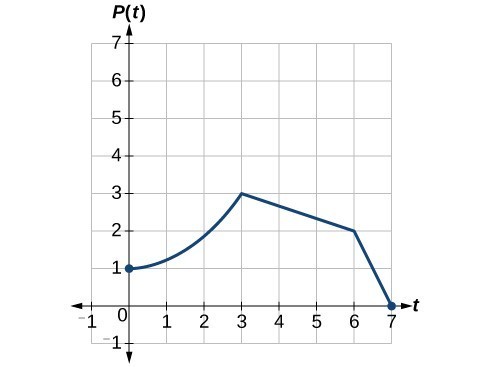
Effigy 15
A function [latex]P\left(t\right)[/latex] models the population of fruit flies.
A scientist is comparing this population to another population, [latex]Q[/latex], whose growth follows the aforementioned blueprint, merely is twice as large. Sketch a graph of this population.
Solution
Considering the population is always twice as large, the new population's output values are always twice the original function'due south output values.
If we choose four reference points, (0, ane), (3, 3), (6, 2) and (7, 0) nosotros will multiply all of the outputs by two.
The following shows where the new points for the new graph will be located.
[latex]\begin{cases}\left(0,\text{ }1\correct)\to \left(0,\text{ }two\correct)\hfill \\ \left(iii,\text{ }three\correct)\to \left(3,\text{ }half-dozen\correct)\hfill \\ \left(6,\text{ }two\right)\to \left(vi,\text{ }4\right)\hfill \\ \left(vii,\text{ }0\correct)\to \left(7,\text{ }0\right)\hfill \end{cases}[/latex]
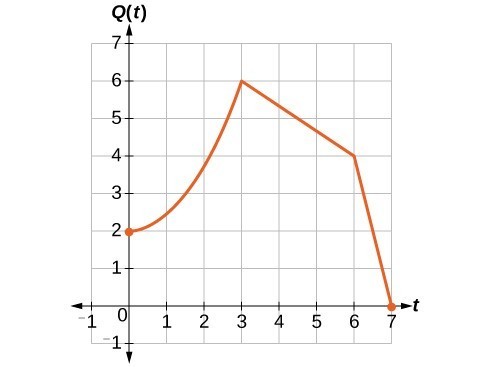
Figure 16
Symbolically, the relationship is written as
[latex]Q\left(t\correct)=2P\left(t\right)[/latex]
This means that for any input [latex]t[/latex], the value of the function [latex]Q[/latex] is twice the value of the office [latex]P[/latex]. Notice that the effect on the graph is a vertical stretching of the graph, where every betoken doubles its distance from the horizontal axis. The input values, [latex]t[/latex], stay the same while the output values are twice every bit large as before.
How To: Given a tabular function and assuming that the transformation is a vertical stretch or compression, create a table for a vertical compression.
- Decide the value of [latex]a[/latex].
- Multiply all of the output values by [latex]a[/latex].
Example 11: Finding a Vertical Compression of a Tabular Office
A function [latex]f[/latex] is given in the table beneath. Create a table for the function [latex]m\left(x\correct)=\frac{1}{2}f\left(10\correct)[/latex].
| [latex]ten[/latex] | 2 | four | six | 8 |
| [latex]f\left(10\right)[/latex] | one | 3 | 7 | 11 |
Solution
The formula [latex]g\left(x\right)=\frac{1}{ii}f\left(10\correct)[/latex] tells the states that the output values of [latex]k[/latex] are one-half of the output values of [latex]f[/latex] with the same inputs. For example, we know that [latex]f\left(4\correct)=three[/latex]. Then
[latex]g\left(4\right)=\frac{one}{ii}f\left(4\right)=\frac{1}{two}\left(iii\correct)=\frac{3}{2}[/latex]
We do the same for the other values to produce this tabular array.
| [latex]x[/latex] | [latex]2[/latex] | [latex]4[/latex] | [latex]half dozen[/latex] | [latex]8[/latex] |
| [latex]grand\left(x\right)[/latex] | [latex]\frac{i}{two}[/latex] | [latex]\frac{three}{2}[/latex] | [latex]\frac{7}{ii}[/latex] | [latex]\frac{11}{ii}[/latex] |
Try Information technology v
A office [latex]f[/latex] is given below. Create a table for the role [latex]g\left(x\correct)=\frac{3}{4}f\left(x\right)[/latex].
| [latex]x[/latex] | 2 | iv | half-dozen | eight |
| [latex]f\left(x\correct)[/latex] | 12 | sixteen | 20 | 0 |
Solution
Example 12: Recognizing a Vertical Stretch
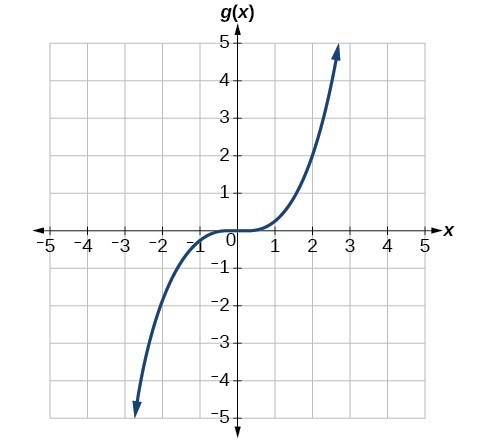
Effigy 17
The graph is a transformation of the toolkit function [latex]f\left(10\correct)={ten}^{three}[/latex]. Relate this new function [latex]thou\left(x\right)[/latex] to [latex]f\left(x\right)[/latex], and then observe a formula for [latex]thousand\left(x\right)[/latex].
Solution
When trying to make up one's mind a vertical stretch or shift, it is helpful to look for a point on the graph that is relatively clear. In this graph, it appears that [latex]g\left(two\right)=two[/latex]. With the basic cubic function at the same input, [latex]f\left(2\right)={ii}^{iii}=eight[/latex]. Based on that, it appears that the outputs of [latex]1000[/latex] are [latex]\frac{ane}{4}[/latex] the outputs of the function [latex]f[/latex] because [latex]g\left(2\correct)=\frac{one}{four}f\left(ii\right)[/latex]. From this nosotros can adequately safely conclude that [latex]yard\left(x\right)=\frac{i}{iv}f\left(x\correct)[/latex].
We tin write a formula for [latex]thousand[/latex] by using the definition of the function [latex]f[/latex].
[latex]g\left(x\right)=\frac{i}{four}f\left(x\right)=\frac{1}{4}{10}^{3}[/latex]
Try It 6
Write the formula for the function that we get when we stretch the identity toolkit function by a factor of 3, and then shift it downwards by 2 units.
Solution
Horizontal Stretches and Compressions
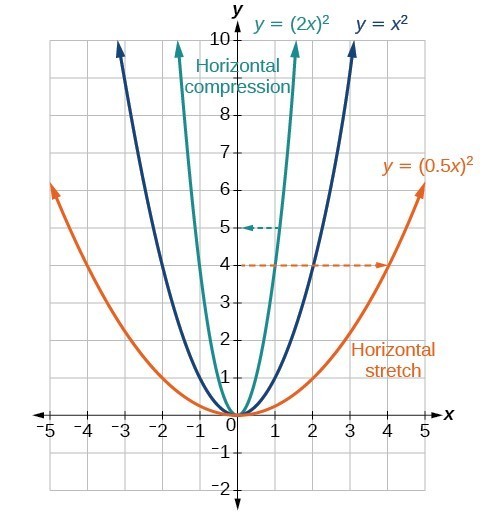
Figure xviii
Now we consider changes to the inside of a part. When we multiply a office's input by a positive constant, we get a role whose graph is stretched or compressed horizontally in relation to the graph of the original office. If the constant is between 0 and 1, we become a horizontal stretch; if the constant is greater than 1, we get a horizontal compression of the function.
Given a function [latex]y=f\left(10\right)[/latex], the course [latex]y=f\left(bx\correct)[/latex] results in a horizontal stretch or compression. Consider the function [latex]y={x}^{2}[/latex]. The graph of [latex]y={\left(0.5x\right)}^{2}[/latex] is a horizontal stretch of the graph of the part [latex]y={x}^{2}[/latex] by a factor of two. The graph of [latex]y={\left(2x\right)}^{2}[/latex] is a horizontal compression of the graph of the function [latex]y={x}^{two}[/latex] by a factor of 2.
A General Note: Horizontal Stretches and Compressions
Given a function [latex]f\left(x\right)[/latex], a new office [latex]one thousand\left(x\correct)=f\left(bx\right)[/latex], where [latex]b[/latex] is a constant, is a horizontal stretch or horizontal compression of the function [latex]f\left(x\right)[/latex].
- If [latex]b>ane[/latex], then the graph will be compressed by [latex]\frac{one}{b}[/latex].
- If [latex]0<b<ane[/latex], then the graph volition be stretched by [latex]\frac{1}{b}[/latex].
- If [latex]b<0[/latex], and so there volition be combination of a horizontal stretch or pinch with a horizontal reflection.
How To: Given a description of a role, sketch a horizontal compression or stretch.
- Write a formula to represent the function.
- Fix [latex]one thousand\left(10\right)=f\left(bx\right)[/latex] where [latex]b>1[/latex] for a pinch or [latex]0<b<1[/latex]
for a stretch.
Example 13: Graphing a Horizontal Compression
Suppose a scientist is comparing a population of fruit flies to a population that progresses through its lifespan twice as fast every bit the original population. In other words, this new population, [latex]R[/latex], will progress in 1 60 minutes the same amount as the original population does in 2 hours, and in 2 hours, it volition progress as much as the original population does in 4 hours. Sketch a graph of this population.
Solution
Symbolically, we could write
[latex]\begin{cases}R\left(1\right)=P\left(2\correct),\hfill \\ R\left(two\correct)=P\left(4\right),\text{ and in general,}\hfill \\ R\left(t\correct)=P\left(2t\right).\hfill \end{cases}[/latex]
See below for a graphical comparison of the original population and the compressed population.
![Two side-by-side graphs. The first graph has function for original population whose domain is [0,7] and range is [0,3]. The maximum value occurs at (3,3). The second graph has the same shape as the first except it is half as wide. It is a graph of transformed population, with a domain of [0, 3.5] and a range of [0,3]. The maximum occurs at (1.5, 3).](https://s3-us-west-2.amazonaws.com/courses-images-archive-read-only/wp-content/uploads/sites/1227/2015/04/03005100/CNX_Precalc_Figure_01_05_029ab.jpg)
Figure nineteen. (a) Original population graph (b) Compressed population graph
Instance 14: Finding a Horizontal Stretch for a Tabular Function
A office [latex]f\left(x\correct)[/latex] is given beneath. Create a table for the part [latex]g\left(ten\right)=f\left(\frac{ane}{2}x\correct)[/latex].
| [latex]ten[/latex] | 2 | four | 6 | viii |
| [latex]f\left(x\correct)[/latex] | 1 | 3 | 7 | 11 |
Solution
The formula [latex]g\left(10\right)=f\left(\frac{1}{2}x\correct)[/latex] tells us that the output values for [latex]g[/latex] are the same as the output values for the function [latex]f[/latex] at an input half the size. Notice that nosotros exercise not have enough information to determine [latex]g\left(2\correct)[/latex] because [latex]k\left(ii\correct)=f\left(\frac{i}{2}\cdot 2\right)=f\left(1\right)[/latex], and we do not take a value for [latex]f\left(1\right)[/latex] in our table. Our input values to [latex]g[/latex] will need to be twice as large to get inputs for [latex]f[/latex] that we tin evaluate. For example, we can determine [latex]g\left(iv\right)\text{.}[/latex]
[latex]g\left(4\right)=f\left(\frac{1}{2}\cdot iv\right)=f\left(two\correct)=1[/latex]
We do the same for the other values to produce the table beneath.
| [latex]x[/latex] | 4 | 8 | 12 | 16 |
| [latex]1000\left(x\right)[/latex] | 1 | 3 | seven | xi |
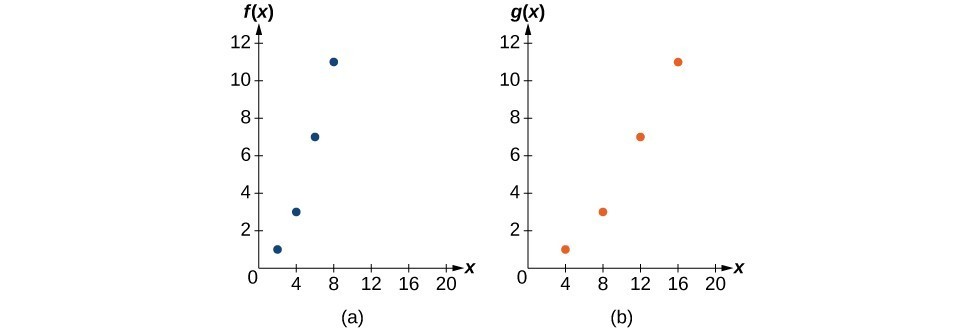
Figure twenty
This figure shows the graphs of both of these sets of points.
Example xv: Recognizing a Horizontal Pinch on a Graph
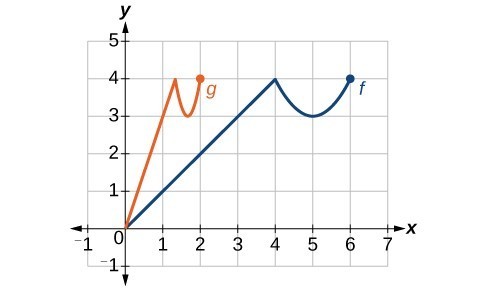
Relate the function [latex]m\left(ten\correct)[/latex] to [latex]f\left(x\right)[/latex] in Figure 21.
Effigy 21
Solution
The graph of [latex]g\left(ten\right)[/latex] looks like the graph of [latex]f\left(ten\right)[/latex] horizontally compressed. Because [latex]f\left(ten\correct)[/latex] ends at [latex]\left(6,four\right)[/latex] and [latex]m\left(10\correct)[/latex] ends at [latex]\left(ii,4\right)[/latex], we can see that the [latex]ten\text{-}[/latex] values have been compressed by [latex]\frac{1}{iii}[/latex], because [latex]6\left(\frac{one}{iii}\right)=2[/latex]. We might also detect that [latex]g\left(2\right)=f\left(half-dozen\correct)[/latex] and [latex]k\left(i\right)=f\left(3\right)[/latex]. Either way, we can describe this human relationship equally [latex]g\left(x\right)=f\left(3x\right)[/latex]. This is a horizontal pinch past [latex]\frac{1}{3}[/latex].
Try Information technology vii
Write a formula for the toolkit square root function horizontally stretched by a gene of 3.
Solution
Combining Vertical and Horizontal Shifts
Now that we have two transformations, we tin can combine them together. Vertical shifts are exterior changes that touch the output ( [latex]y\text{-}[/latex] ) axis values and shift the function upwards or downwardly. Horizontal shifts are inside changes that affect the input ( [latex]x\text{-}[/latex] ) axis values and shift the office left or correct. Combining the two types of shifts volition cause the graph of a office to shift upwardly or down and correct or left.
How To: Given a part and both a vertical and a horizontal shift, sketch the graph.
- Identify the vertical and horizontal shifts from the formula.
- The vertical shift results from a abiding added to the output. Move the graph upward for a positive abiding and downward for a negative constant.
- The horizontal shift results from a constant added to the input. Move the graph left for a positive abiding and right for a negative abiding.
- Apply the shifts to the graph in either order.
Case 16: Graphing Combined Vertical and Horizontal Shifts
Given [latex]f\left(ten\right)=|x|[/latex], sketch a graph of [latex]h\left(10\right)=f\left(ten+1\right)-3[/latex].
The part [latex]f[/latex] is our toolkit absolute value function. We know that this graph has a 5 shape, with the point at the origin. The graph of [latex]h[/latex] has transformed [latex]f[/latex] in 2 ways: [latex]f\left(x+1\right)[/latex] is a change on the inside of the part, giving a horizontal shift left by 1, and the subtraction by 3 in [latex]f\left(x+ane\right)-iii[/latex] is a change to the outside of the function, giving a vertical shift down past 3. The transformation of the graph is illustrated in Figure 22.
Permit us follow one point of the graph of [latex]f\left(x\right)=|x|[/latex].
- The point [latex]\left(0,0\right)[/latex] is transformed get-go by shifting left i unit: [latex]\left(0,0\right)\to \left(-1,0\right)[/latex]
- The indicate [latex]\left(-one,0\right)[/latex] is transformed next by shifting down three units: [latex]\left(-1,0\right)\to \left(-1,-3\right)[/latex]

Figure 22
Figure 23 is the graph of [latex]h[/latex].
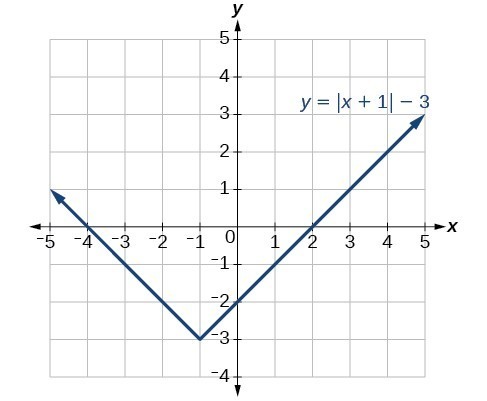
Figure 23
Try It 8
Given [latex]f\left(x\correct)=|x|[/latex], sketch a graph of [latex]h\left(ten\correct)=f\left(x - ii\right)+4[/latex].
Solution
Case 17: Identifying Combined Vertical and Horizontal Shifts
Write a formula for the graph shown in Figure 24, which is a transformation of the toolkit foursquare root function.
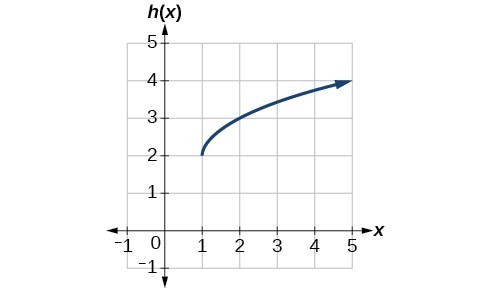
Figure 24
Solution
The graph of the toolkit office starts at the origin, so this graph has been shifted 1 to the right and upward two. In function notation, nosotros could write that as
[latex]h\left(10\correct)=f\left(x - i\right)+2[/latex]
Using the formula for the square root function, we tin can write
[latex]h\left(ten\right)=\sqrt{x - 1}+two[/latex]
Endeavor It nine
Write a formula for a transformation of the toolkit reciprocal function [latex]f\left(x\correct)=\frac{ane}{x}[/latex] that shifts the office's graph one unit to the right and i unit of measurement upwardly.
Solution
Example eighteen: Applying a Learning Model Equation
A common model for learning has an equation like to [latex]g\left(t\right)=-{ii}^{-t}+1[/latex], where [latex]k[/latex] is the percentage of mastery that can exist accomplished afterwards [latex]t[/latex] exercise sessions. This is a transformation of the part [latex]f\left(t\correct)={2}^{t}[/latex] shown in Figure 25. Sketch a graph of [latex]k\left(t\correct)[/latex].
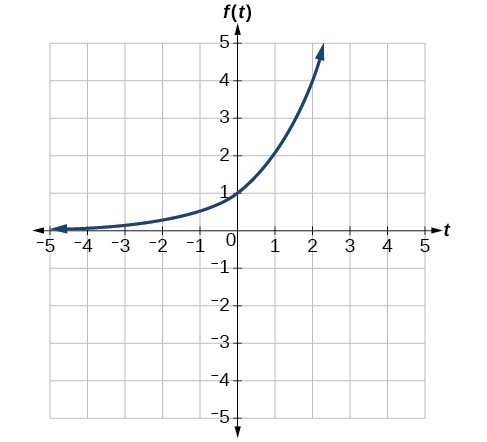
Figure 25
Solution
This equation combines three transformations into ane equation.
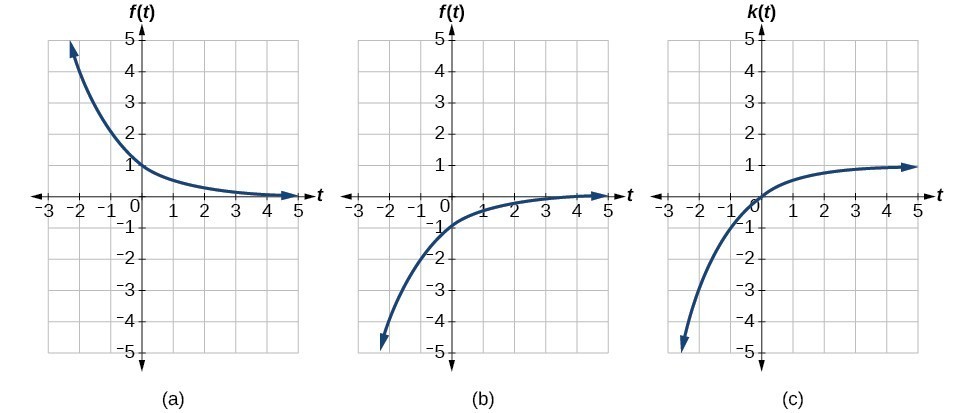
- A horizontal reflection: [latex]f\left(-t\right)={2}^{-t}[/latex]
- A vertical reflection: [latex]-f\left(-t\right)=-{2}^{-t}[/latex]
- A vertical shift: [latex]-f\left(-t\right)+one=-{2}^{-t}+one[/latex]
We tin can sketch a graph past applying these transformations 1 at a time to the original office. Let us follow two points through each of the 3 transformations. We will choose the points (0, 1) and (1, 2).
- First, nosotros apply a horizontal reflection: (0, 1) (–1, 2).
- Then, we employ a vertical reflection: (0, −i) (1, –2).
- Finally, we utilise a vertical shift: (0, 0) (ane, 1).
This means that the original points, (0,1) and (ane,ii) become (0,0) and (one,1) after we apply the transformations.
In Figure 26, the first graph results from a horizontal reflection. The 2nd results from a vertical reflection. The tertiary results from a vertical shift upward 1 unit.
Effigy 26
Endeavor It 10
Given the toolkit function [latex]f\left(x\right)={ten}^{2}[/latex], graph [latex]g\left(x\right)=-f\left(ten\right)[/latex] and [latex]h\left(ten\right)=f\left(-ten\right)[/latex]. Accept note of any surprising beliefs for these functions.
Solution
Performing a Sequence of Transformations
When combining transformations, it is very of import to consider the society of the transformations. For case, vertically shifting by three and then vertically stretching by ii does not create the aforementioned graph as vertically stretching by 2 and and so vertically shifting by iii, considering when nosotros shift outset, both the original office and the shift go stretched, while only the original function gets stretched when nosotros stretch first.
When we see an expression such every bit [latex]2f\left(x\right)+iii[/latex], which transformation should nosotros kickoff with? The answer here follows nicely from the order of operations. Given the output value of [latex]f\left(x\right)[/latex], we first multiply past two, causing the vertical stretch, and then add together three, causing the vertical shift. In other words, multiplication before addition.
Horizontal transformations are a trivial trickier to think about. When we write [latex]grand\left(x\right)=f\left(2x+3\right)[/latex], for instance, we take to think about how the inputs to the part [latex]g[/latex] relate to the inputs to the office [latex]f[/latex]. Suppose we know [latex]f\left(7\right)=12[/latex]. What input to [latex]g[/latex] would produce that output? In other words, what value of [latex]x[/latex] will let [latex]thousand\left(10\right)=f\left(2x+iii\right)=12?[/latex] We would need [latex]2x+3=vii[/latex]. To solve for [latex]x[/latex], we would offset subtract iii, resulting in a horizontal shift, and then carve up by 2, causing a horizontal compression.
This format ends up beingness very difficult to work with, because it is unremarkably much easier to horizontally stretch a graph earlier shifting. Nosotros can work around this by factoring inside the function.
[latex]f\left(bx+p\right)=f\left(b\left(x+\frac{p}{b}\right)\right)[/latex]
Allow's work through an example.
[latex]f\left(x\right)={\left(2x+4\right)}^{2}[/latex]
We can cistron out a 2.
[latex]f\left(x\right)={\left(2\left(x+2\correct)\right)}^{ii}[/latex]
At present we can more conspicuously discover a horizontal shift to the left 2 units and a horizontal pinch. Factoring in this style allows usa to horizontally stretch first so shift horizontally.
A General Annotation: Combining Transformations
When combining vertical transformations written in the class [latex]af\left(x\right)+k[/latex], first vertically stretch past [latex]a[/latex] and then vertically shift by [latex]thou[/latex].
When combining horizontal transformations written in the class [latex]f\left(bx+h\correct)[/latex], first horizontally shift by [latex]h[/latex] and so horizontally stretch by [latex]\frac{i}{b}[/latex].
When combining horizontal transformations written in the form [latex]f\left(b\left(x+h\correct)\right)[/latex], beginning horizontally stretch by [latex]\frac{1}{b}[/latex] and so horizontally shift by [latex]h[/latex].
Horizontal and vertical transformations are independent. It does not matter whether horizontal or vertical transformations are performed commencement.
Example 19: Finding a Triple Transformation of a Tabular Function
Given the table below for the office [latex]f\left(10\right)[/latex], create a tabular array of values for the part [latex]g\left(x\right)=2f\left(3x\right)+ane[/latex].
| [latex]x[/latex] | half-dozen | 12 | 18 | 24 |
| [latex]f\left(x\right)[/latex] | x | 14 | fifteen | 17 |
Solution
There are three steps to this transformation, and we will work from the inside out. Starting with the horizontal transformations, [latex]f\left(3x\right)[/latex] is a horizontal compression by [latex]\frac{1}{iii}[/latex], which means we multiply each [latex]x\text{-}[/latex] value by [latex]\frac{i}{iii}[/latex].
| [latex]x[/latex] | 2 | iv | half dozen | eight |
| [latex]f\left(3x\right)[/latex] | ten | 14 | 15 | 17 |
Looking now to the vertical transformations, nosotros start with the vertical stretch, which will multiply the output values past 2. We apply this to the previous transformation.
| [latex]x[/latex] | 2 | iv | 6 | 8 |
| [latex]2f\left(3x\right)[/latex] | 20 | 28 | 30 | 34 |
Finally, we tin can utilise the vertical shift, which will add together 1 to all the output values.
| [latex]x[/latex] | ii | 4 | 6 | 8 |
| [latex]1000\left(x\right)=2f\left(3x\right)+1[/latex] | 21 | 29 | 31 | 35 |
Example twenty: Finding a Triple Transformation of a Graph
Use the graph of [latex]f\left(x\right)[/latex] to sketch a graph of [latex]yard\left(x\right)=f\left(\frac{1}{2}x+one\right)-three[/latex].
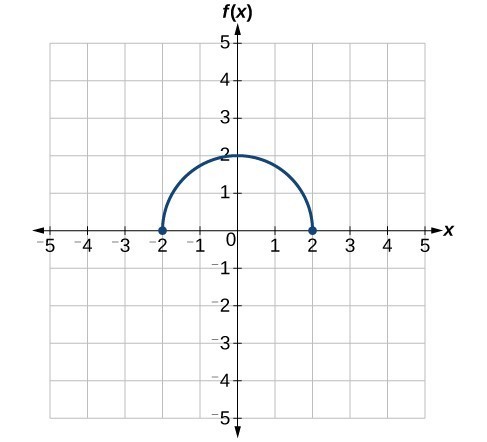
Figure 27
Solution
To simplify, let's showtime by factoring out the within of the part.
[latex]f\left(\frac{1}{2}x+1\right)-3=f\left(\frac{1}{two}\left(x+two\right)\correct)-3[/latex]
Past factoring the inside, we tin starting time horizontally stretch by two, every bit indicated by the [latex]\frac{1}{2}[/latex] on the inside of the role. Remember that twice the size of 0 is still 0, then the point (0,2) remains at (0,2) while the betoken (2,0) volition stretch to (4,0).
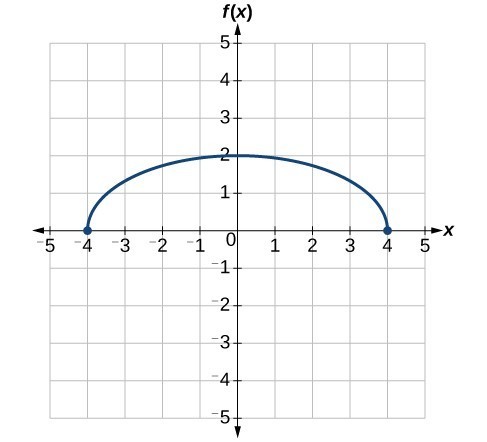
Figure 28
Next, nosotros horizontally shift left by ii units, every bit indicated by [latex]10+2[/latex].
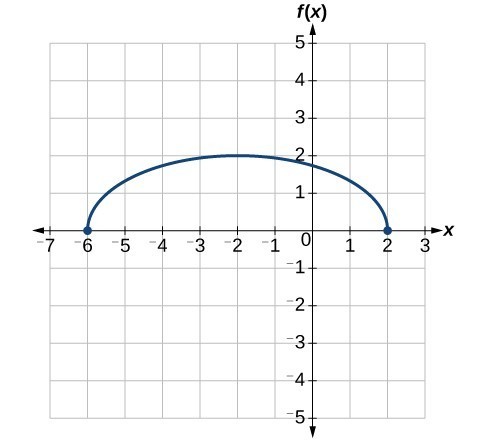
Figure 29
Concluding, we vertically shift down past iii to consummate our sketch, equally indicated past the [latex]-3[/latex] on the outside of the function.
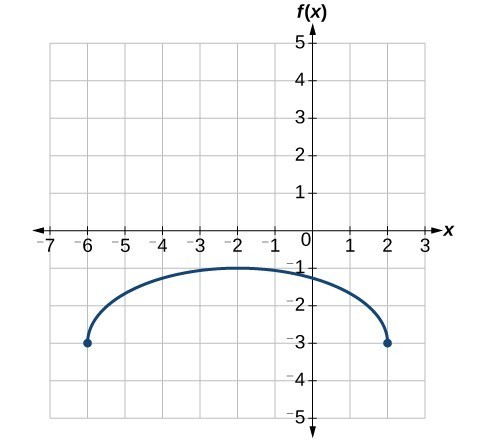
Figure 30
Primal Equations
| Vertical shift | [latex]thou\left(10\correct)=f\left(ten\right)+k[/latex] (up for [latex]k>0[/latex] ) |
| Horizontal shift | [latex]k\left(ten\right)=f\left(x-h\right)[/latex] (right for [latex]h>0[/latex] ) |
| Vertical reflection | [latex]yard\left(x\right)=-f\left(x\right)[/latex] |
| Horizontal reflection | [latex]m\left(x\right)=f\left(-x\right)[/latex] |
| Vertical stretch | [latex]yard\left(x\right)=af\left(x\correct)[/latex] ( [latex]a>0[/latex]) |
| Vertical compression | [latex]one thousand\left(ten\right)=af\left(ten\right)[/latex] [latex]\left(0<a<one\right)[/latex] |
| Horizontal stretch | [latex]1000\left(10\right)=f\left(bx\right)[/latex] [latex]\left(0<b<one\right)[/latex] |
| Horizontal pinch | [latex]g\left(x\right)=f\left(bx\right)[/latex] ( [latex]b>1[/latex] ) |
Key Concepts
- A function can be shifted vertically by adding a abiding to the output.
- A function can exist shifted horizontally past adding a constant to the input.
- Relating the shift to the context of a trouble makes it possible to compare and interpret vertical and horizontal shifts.
- Vertical and horizontal shifts are often combined.
- A vertical reflection reflects a graph about the [latex]x\text{-}[/latex] axis. A graph tin exist reflected vertically by multiplying the output by –1.
- A horizontal reflection reflects a graph almost the [latex]y\text{-}[/latex] axis. A graph can exist reflected horizontally by multiplying the input by –one.
- A graph can be reflected both vertically and horizontally. The order in which the reflections are applied does not bear on the final graph.
- A function presented in tabular course can also be reflected by multiplying the values in the input and output rows or columns accordingly.
- A role presented equally an equation can be reflected past applying transformations one at a time.
- Even functions are symmetric near the [latex]y\text{-}[/latex] centrality, whereas odd functions are symmetric about the origin.
- Even functions satisfy the status [latex]f\left(ten\right)=f\left(-10\right)[/latex].
- Odd functions satisfy the condition [latex]f\left(x\right)=-f\left(-ten\correct)[/latex].
- A function can be odd, even, or neither.
- A function tin can be compressed or stretched vertically by multiplying the output by a abiding.
- A office can exist compressed or stretched horizontally by multiplying the input by a constant.
- The order in which unlike transformations are applied does bear on the final function. Both vertical and horizontal transformations must exist applied in the society given. However, a vertical transformation may be combined with a horizontal transformation in whatsoever guild.
Glossary
- even function
- a part whose graph is unchanged by horizontal reflection, [latex]f\left(10\right)=f\left(-x\right)[/latex], and is symmetric virtually the [latex]y\text{-}[/latex] axis
- horizontal compression
- a transformation that compresses a function'due south graph horizontally, by multiplying the input by a constant [latex]b>1[/latex]
- horizontal reflection
- a transformation that reflects a office's graph beyond the y-axis by multiplying the input by [latex]-1[/latex]
- horizontal shift
- a transformation that shifts a part's graph left or right past adding a positive or negative constant to the input
- horizontal stretch
- a transformation that stretches a role's graph horizontally by multiplying the input by a constant [latex]0<b<1[/latex]
- odd function
- a function whose graph is unchanged by combined horizontal and vertical reflection, [latex]f\left(x\right)=-f\left(-ten\correct)[/latex], and is symmetric about the origin
- vertical compression
- a function transformation that compresses the function'south graph vertically by multiplying the output by a abiding [latex]0<a<one[/latex]
- vertical reflection
- a transformation that reflects a office's graph across the x-axis by multiplying the output by [latex]-i[/latex]
- vertical shift
- a transformation that shifts a office's graph up or down by adding a positive or negative constant to the output
- vertical stretch
- a transformation that stretches a office's graph vertically past multiplying the output by a abiding [latex]a>one[/latex]
1. When examining the formula of a role that is the result of multiple transformations, how tin can yous tell a horizontal shift from a vertical shift?
ii. When examining the formula of a function that is the result of multiple transformations, how can you tell a horizontal stretch from a vertical stretch?
3. When examining the formula of a function that is the event of multiple transformations, how tin can you tell a horizontal compression from a vertical compression?
4. When examining the formula of a function that is the outcome of multiple transformations, how can yous tell a reflection with respect to the x-axis from a reflection with respect to the y-centrality?
five. How can you determine whether a office is odd or even from the formula of the function?
half-dozen. Write a formula for the part obtained when the graph of [latex]f\left(10\right)=\sqrt{x}[/latex] is shifted up 1 unit and to the left two units.
7. Write a formula for the role obtained when the graph of [latex]f\left(10\right)=|x|[/latex]
is shifted downwardly 3 units and to the right one unit.
8. Write a formula for the office obtained when the graph of [latex]f\left(x\right)=\frac{1}{x}[/latex] is shifted down 4 units and to the correct 3 units.
9. Write a formula for the function obtained when the graph of [latex]f\left(x\right)=\frac{1}{{x}^{2}}[/latex] is shifted up ii units and to the left 4 units.
For the following exercises, describe how the graph of the function is a transformation of the graph of the original role [latex]f[/latex].
10. [latex]y=f\left(x - 49\correct)[/latex]
eleven. [latex]y=f\left(x+43\right)[/latex]
12. [latex]y=f\left(x+iii\correct)[/latex]
13. [latex]y=f\left(x - four\right)[/latex]
xiv. [latex]y=f\left(x\correct)+v[/latex]
15. [latex]y=f\left(x\right)+viii[/latex]
sixteen. [latex]y=f\left(ten\right)-2[/latex]
17. [latex]y=f\left(x\right)-7[/latex]
eighteen. [latex]y=f\left(x - two\right)+3[/latex]
19. [latex]y=f\left(x+4\right)-1[/latex]
For the following exercises, determine the interval(s) on which the function is increasing and decreasing.
20. [latex]f\left(ten\correct)=4{\left(x+ane\right)}^{2}-5[/latex]
21. [latex]thou\left(x\right)=five{\left(x+3\correct)}^{2}-two[/latex]
22. [latex]a\left(x\right)=\sqrt{-x+four}[/latex]
23. [latex]thousand\left(ten\correct)=-three\sqrt{ten}-ane[/latex]
For the following exercises, use the graph of [latex]f\left(x\correct)={ii}^{x}[/latex] to sketch a graph of each transformation of [latex]f\left(x\right)[/latex].
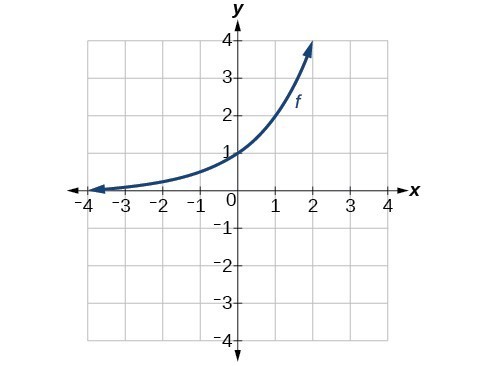
24. [latex]g\left(ten\right)={2}^{x}+1[/latex]
25. [latex]h\left(x\right)={2}^{x}-3[/latex]
26. [latex]w\left(x\right)={2}^{x - 1}[/latex]
For the post-obit exercises, sketch a graph of the function as a transformation of the graph of ane of the toolkit functions.
27. [latex]f\left(t\right)={\left(t+1\right)}^{2}-3[/latex]
28. [latex]h\left(10\right)=|ten - 1|+four[/latex]
29. [latex]one thousand\left(ten\right)={\left(x - two\correct)}^{three}-1[/latex]
30. [latex]grand\left(t\right)=3+\sqrt{t+2}[/latex]
31. Tabular representations for the functions [latex]f,thou[/latex], and [latex]h[/latex] are given below. Write [latex]1000\left(x\correct)[/latex] and [latex]h\left(x\right)[/latex] as transformations of [latex]f\left(10\right)[/latex].
| [latex]x[/latex] | −2 | −1 | 0 | 1 | 2 |
| [latex]f\left(ten\correct)[/latex] | −2 | −1 | −3 | 1 | 2 |
| [latex]x[/latex] | −1 | 0 | ane | two | 3 |
| [latex]g\left(x\right)[/latex] | −2 | −1 | −3 | 1 | ii |
| [latex]10[/latex] | −2 | −1 | 0 | ane | 2 |
| [latex]h\left(x\right)[/latex] | −1 | 0 | −2 | 2 | 3 |
32. Tabular representations for the functions [latex]f,g[/latex], and [latex]h[/latex] are given below. Write [latex]g\left(ten\right)[/latex] and [latex]h\left(x\right)[/latex] as transformations of [latex]f\left(10\right)[/latex].
| [latex]10[/latex] | −2 | −1 | 0 | 1 | 2 |
| [latex]f\left(x\right)[/latex] | −one | −3 | four | 2 | 1 |
| [latex]x[/latex] | −three | −2 | −1 | 0 | 1 |
| [latex]one thousand\left(x\right)[/latex] | −ane | −3 | four | 2 | 1 |
| [latex]x[/latex] | −2 | −1 | 0 | i | two |
| [latex]h\left(x\correct)[/latex] | −ii | −four | 3 | 1 | 0 |
For the following exercises, write an equation for each graphed role past using transformations of the graphs of one of the toolkit functions.
33.
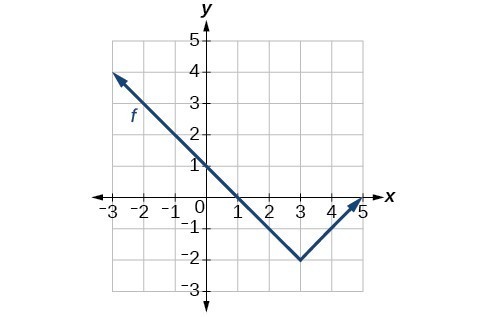
34.
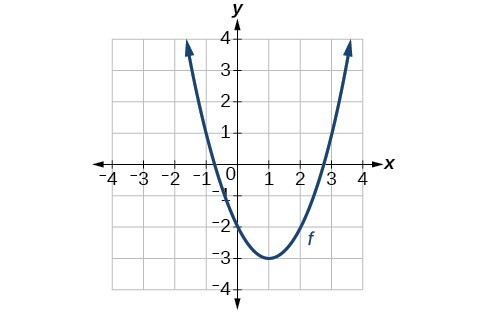
35.
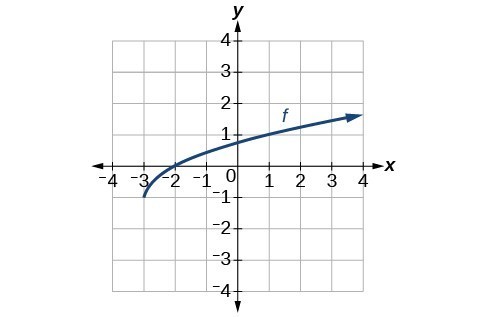
36.
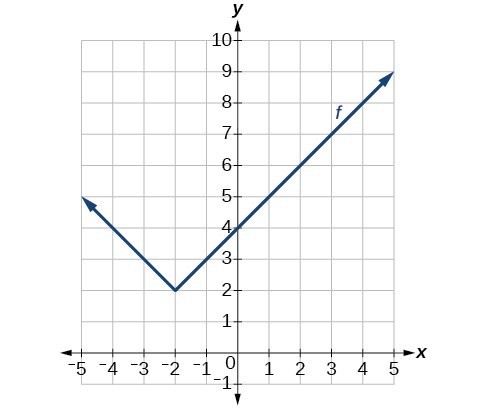
37.
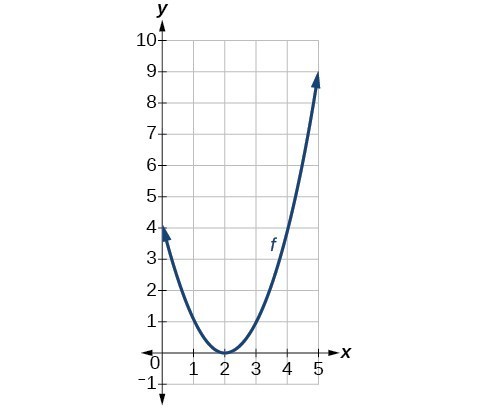
38.
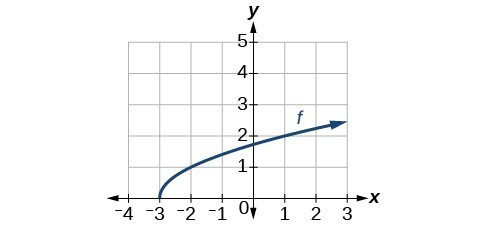
39.
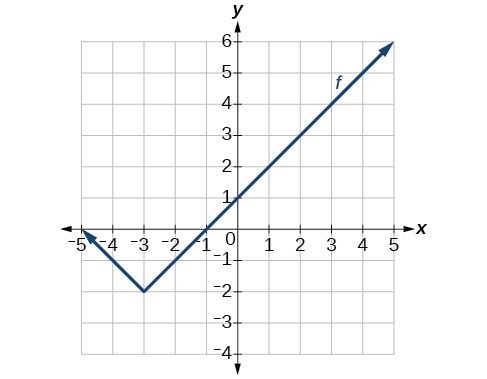
twoscore.
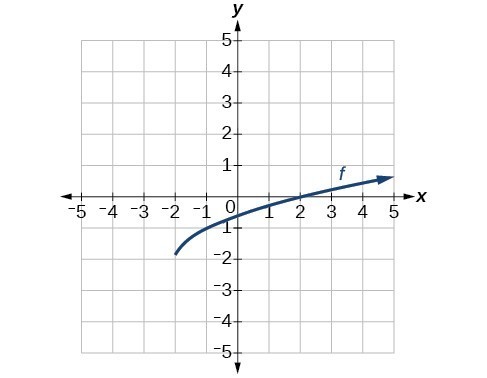
For the following exercises, employ the graphs of transformations of the square root function to notice a formula for each of the functions.
41.
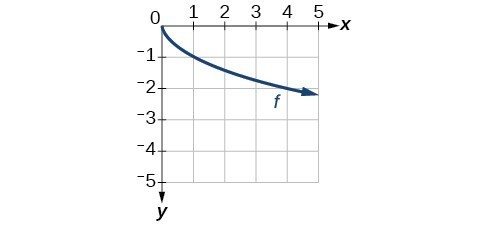
42.
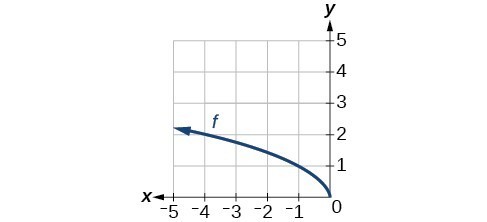
For the post-obit exercises, utilise the graphs of the transformed toolkit functions to write a formula for each of the resulting functions.
43.
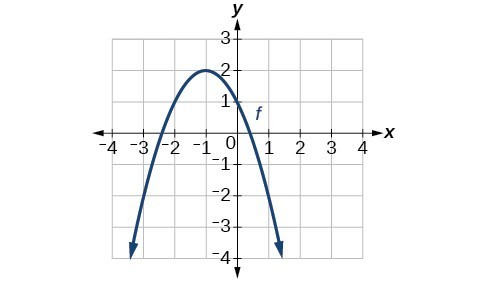
44.
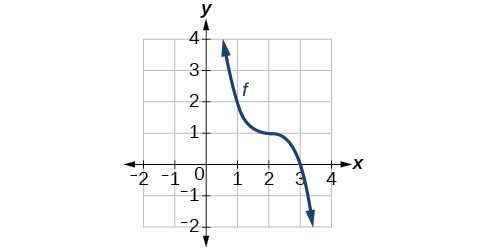
45.
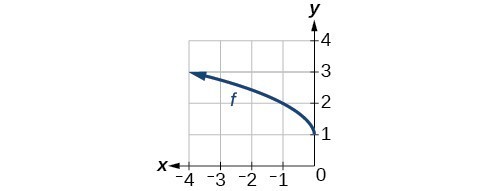
46.
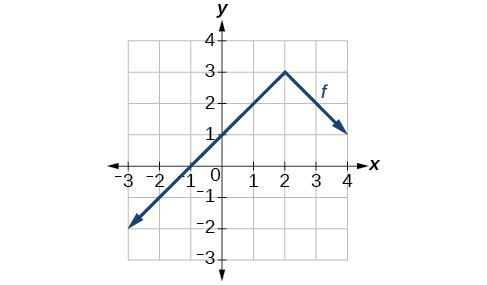
For the following exercises, determine whether the part is odd, even, or neither.
47. [latex]f\left(x\right)=3{x}^{4}[/latex]
48. [latex]m\left(x\right)=\sqrt{x}[/latex]
49. [latex]h\left(x\right)=\frac{1}{10}+3x[/latex]
50. [latex]f\left(x\right)={\left(x - 2\right)}^{two}[/latex]
51. [latex]g\left(x\right)=2{x}^{4}[/latex]
52. [latex]h\left(x\correct)=2x-{10}^{iii}[/latex]
For the following exercises, draw how the graph of each role is a transformation of the graph of the original function [latex]f[/latex].
53. [latex]grand\left(10\right)=-f\left(x\correct)[/latex]
54. [latex]k\left(x\right)=f\left(-10\correct)[/latex]
55. [latex]g\left(x\right)=4f\left(ten\right)[/latex]
56. [latex]thousand\left(x\right)=6f\left(x\correct)[/latex]
57. [latex]one thousand\left(x\right)=f\left(5x\right)[/latex]
58. [latex]g\left(x\correct)=f\left(2x\right)[/latex]
59. [latex]g\left(x\right)=f\left(\frac{1}{3}x\right)[/latex]
60. [latex]g\left(x\right)=f\left(\frac{1}{5}ten\correct)[/latex]
61. [latex]thou\left(ten\right)=3f\left(-ten\right)[/latex]
62. [latex]m\left(x\right)=-f\left(3x\right)[/latex]
For the following exercises, write a formula for the role [latex]chiliad[/latex] that results when the graph of a given toolkit part is transformed as described.
63. The graph of [latex]f\left(x\right)=|x|[/latex] is reflected over the [latex]y[/latex] –axis and horizontally compressed by a gene of [latex]\frac{1}{four}[/latex] .
64. The graph of [latex]f\left(10\right)=\sqrt{x}[/latex] is reflected over the [latex]x[/latex] -axis and horizontally stretched by a factor of ii.
65. The graph of [latex]f\left(x\correct)=\frac{1}{{ten}^{2}}[/latex] is vertically compressed past a factor of [latex]\frac{i}{3}[/latex], then shifted to the left two units and downwards 3 units.
66. The graph of [latex]f\left(x\right)=\frac{ane}{x}[/latex] is vertically stretched by a cistron of 8, and then shifted to the right 4 units and up ii units.
67. The graph of [latex]f\left(10\right)={x}^{2}[/latex] is vertically compressed by a factor of [latex]\frac{1}{2}[/latex], then shifted to the correct 5 units and up 1 unit.
68. The graph of [latex]f\left(x\right)={x}^{two}[/latex] is horizontally stretched by a factor of 3, then shifted to the left 4 units and down iii units.
For the following exercises, describe how the formula is a transformation of a toolkit function. Then sketch a graph of the transformation.
69. [latex]g\left(x\correct)=4{\left(ten+i\right)}^{ii}-5[/latex]
70. [latex]g\left(x\right)=v{\left(x+3\right)}^{2}-2[/latex]
71. [latex]h\left(ten\right)=-2|x - 4|+iii[/latex]
72. [latex]k\left(x\right)=-3\sqrt{x}-1[/latex]
73. [latex]m\left(x\right)=\frac{ane}{2}{ten}^{3}[/latex]
74. [latex]n\left(x\right)=\frac{1}{three}|ten - 2|[/latex]
75. [latex]p\left(x\right)={\left(\frac{i}{3}x\right)}^{3}-three[/latex]
76. [latex]q\left(x\correct)={\left(\frac{1}{4}x\right)}^{3}+one[/latex]
77. [latex]a\left(x\correct)=\sqrt{-x+four}[/latex]
For the post-obit exercises, employ the graph beneath to sketch the given transformations.
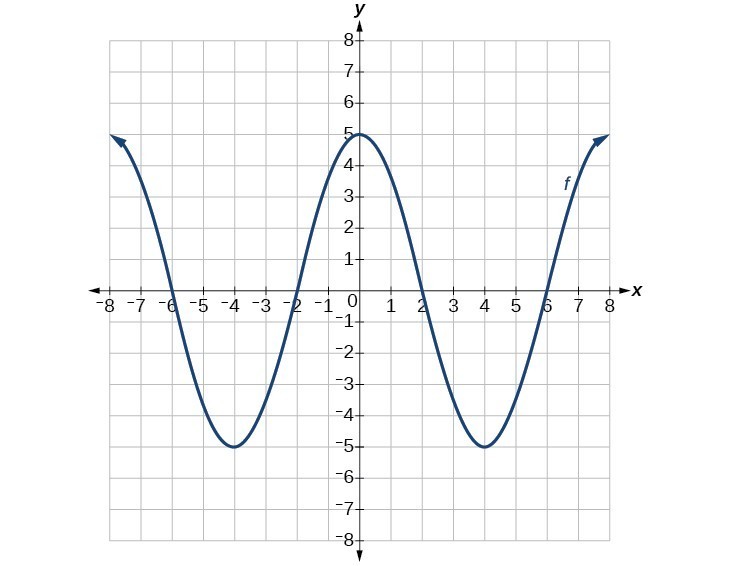
78. [latex]g\left(x\right)=f\left(x\right)-2[/latex]
79. [latex]thousand\left(10\correct)=-f\left(x\right)[/latex]
80. [latex]1000\left(x\right)=f\left(x+one\correct)[/latex]
81. [latex]g\left(ten\right)=f\left(x - two\right)[/latex]
Source: https://courses.lumenlearning.com/precalcone/chapter/transformation-of-functions/
0 Response to "Again Assuming a Transformation From F(T)=-6t^t"
Post a Comment